
Chief Executive Officer
Published: July 24, 2026
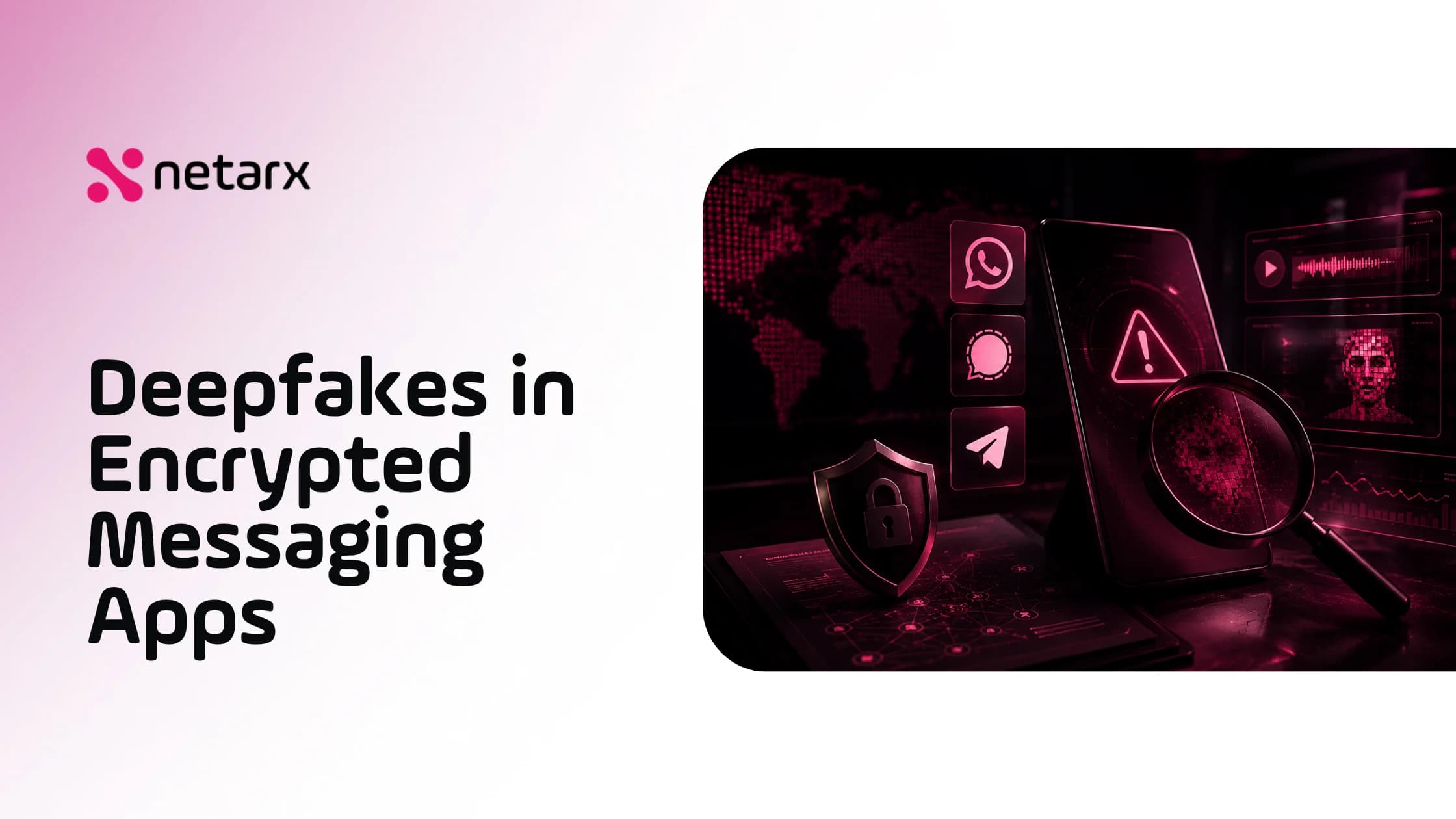
End-to-end encryption protects a message in transit. It does nothing to prove the sender is real or that a voice note, photo, or video is not a deepfake.
Deepfakes reach these apps as cloned voice notes, live voice and video calls, forwarded AI images and videos, and impersonated or hijacked accounts.
Spot them by listening for flat, breathless audio, watching for lip-sync and lighting glitches on calls, and treating any urgent money or code request as suspect.
Telegram-based scam cases surged in 2025, and the apps themselves do not analyze whether audio or video is synthetic. Verification is on you.
Always confirm through a separate trusted channel and a pre-agreed code word. For high-stakes use, add real-time detection like Netarx on mobile calls and messaging.
A messaging deepfake scam is a fraud attempt delivered through a chat app in which the voice, video, image, or identity of the sender is AI-generated. Instead of a suspicious email from a stranger, the target receives a voice note that sounds exactly like their CEO, a video call that shows a family member's face, or a document forwarded by what appears to be a trusted contact all inside an encrypted app they use every day.
Attackers need surprisingly little to pull this off: a few seconds of public audio to clone a voice, a handful of photos to drive a synthetic face, and a spoofed or hijacked account to deliver it. The encrypted channel does the rest, because a message arriving on WhatsApp, Signal, or Telegram carries an implicit credibility that email lost years ago. It is the same trust hijack behind deepfake video calls on [Zoom, Teams, Meet, and Webex] moved to the app in your pocket.

End-to-end encryption on WhatsApp, Signal, and Telegram protects a message in transit it does nothing to verify who sent it or whether a voice note, image, or video is AI-generated.
Deepfakes arrive through four routes: cloned voice notes, live synthetic voice/video calls, forwarded AI images and clips, and impersonated or hijacked accounts.
Manual tells still catch many fakes: flat, breathless audio with no background noise, lip-sync drift and lighting mismatches on calls, warped hands and garbled text in images and a fake can't go off-script when asked an unexpected personal question.
The loudest alarm is behavioral, not technical: urgency plus a request for money, crypto, gift cards, or one-time codes should stop you cold, whatever the voice sounds like.
Telegram is the riskiest of the three encryption isn't on by default and scam volume surged in 2025, but no app in this category analyzes media authenticity; verification is on you.
Before acting, verify on a second channel you already trust, use a pre-agreed code word, and slow the conversation down. For high-stakes use, add real-time detection like Netarx across mobile calls and messaging.
In This Article
Not with the apps alone. WhatsApp, Signal, and Telegram encrypt what you send, but they do not verify who is really sending it or whether a voice note, image, or video is AI-generated. You can catch many deepfakes manually by listening for unnatural, breathless audio, watching for lip-sync and lighting glitches on video calls, and treating urgent requests for money or one-time codes as red flags. For anything that matters, verify through a second trusted channel or a pre-agreed code word, and use real-time detection for reliable protection.
Encrypted messaging feels safe, and for good reason: no one in the middle can read your chats. But that padlock guarantees privacy of delivery, not authenticity of content. A perfectly encrypted message can still carry a cloned voice of your CEO, a deepfaked video of a family member, or an AI-generated ID document, and the app will deliver it flawlessly.
That blind spot is being exploited fast. Scam cases originating on Telegram jumped sharply in 2025, and the FBI's IC3 unit logged more than 22,000 AI-fraud complaints with reported losses near $893 million (FBI IC3; Forbes). Here is how deepfakes reach WhatsApp, Signal, and Telegram, how to spot them, and how to verify before you act.
End-to-end encryption solves one problem: keeping a message private between sender and recipient. It says nothing about whether the person on the other end is who they claim to be, or whether the media they sent is genuine. WhatsApp, Signal, and Telegram do not analyze audio or video to determine if it is synthetic, so a deepfake voice note is delivered with the same trusted checkmark as a real one.
Attackers exploit the trust that these apps carry. It is the same social engineering behind vishing, smishing, and phishing, now delivered through a private, encrypted channel that feels inherently more credible than email.
Cloned voice notes. A few seconds of public audio is enough to clone a voice. "Distress" scams that mimic a loved one in an emergency have already driven millions in losses.
Live voice and video calls. Real-time face and voice cloning now runs on ordinary laptops, so a WhatsApp or Telegram video call can feature a fully synthetic caller.
Forwarded AI images and videos. Fake screenshots, doctored documents, and deepfaked clips are shared to lend credibility to an investment pitch or urgent ask.
Impersonated or hijacked accounts. Attackers spoof a familiar name and photo, or take over a real account, then send deepfake media from a contact you already trust.
Voice notes and voice calls
Flat, breathless delivery. Synthetic speech often lacks natural rhythm, breathing, and filler words, or emphasizes the wrong syllables.
Too clean or oddly clipped audio. No background noise at all, abrupt starts and stops, or a slightly robotic tone.
It cannot go off-script. Ask an unexpected personal question. A cloned voice replaying a request struggles to answer naturally in real time.
Video calls
Lip-sync drift. The mouth moves slightly out of step with the words, one of the most reliable tells.
Unnatural eyes and lighting. Mismatched reflections between the eyes, or a face lit differently than the room behind it.
Edge warping and low resolution. Flicker around the hairline or a deliberately soft, dim image that hides artifacts. Ask them to turn their head or wave a hand across their face.
Forwarded images and video
Physics errors. Warped hands, garbled text, inconsistent shadows and reflections, or backgrounds that melt at the edges.
No verifiable source. A dramatic clip or screenshot with no traceable origin, sent to justify an urgent decision.
Behavioral red flags (the loudest alarm)
Urgency and secrecy. An emergency payment, gift-card purchase, or confidential request that pushes you to skip verification.
Requests for money or one-time codes. Any ask to send funds, crypto, or a login or 2FA code should stop you immediately, whatever the voice sounds like.
A number or account you do not recognize. A familiar name messaging from a new number, or a contact whose tone suddenly changes.
WhatsApp is encrypted end-to-end by default, but its huge reach makes it the top target for cloned voice notes and impersonation from spoofed or hijacked accounts. Turn on two-step verification and be wary of familiar names messaging from new numbers. Signal offers the strongest privacy and useful safeguards like safety numbers and username privacy, yet it still cannot tell you whether the audio or video itself is real. Telegram is the highest-risk of the three: end-to-end encryption is not on by default, scam volume on the platform surged in 2025, and deepfake and bot-driven fraud is common in channels and groups. Avoid unsolicited bots and "admin" accounts entirely.
The common thread: none of these apps verifies that a human is genuine or that media is authentic. That gap is why Netarx built deepfake detection into mobile calling and messaging, analyzing interactions in real time rather than trusting the channel.
Whether or not you can name the tell, process protects you. When a message or call feels off:
Do not act on the request. Never send money, crypto, gift cards, or one-time codes based on a voice note, call, or forwarded clip alone.
Verify on a second channel. Call the person back on a number you already have, not one provided in the chat, and confirm the request directly.
Use a family or team code word. Agree on a passphrase in advance so you can instantly verify any urgent caller, a practice the U.S. Federal Trade Commission recommends.
Slow the conversation down. Ask a specific personal question only the real person could answer. Urgency is the scammer's main weapon.
Preserve evidence and report. Save the message, note the number or username, block it, and report fraud to the FBI Internet Crime Complaint Center (IC3). The Arup $25 million deepfake fraud shows how costly skipping verification can be.
Old advice about spotting artifacts is aging quickly. Real-time cloning runs on consumer hardware, and "Scam-as-a-Service" kits package voice cloning, deepfake video, and messaging tools for anyone to rent. On a small phone screen, with a trusted contact name attached, even careful people get fooled. That is why manual vigilance needs a technical backstop. Netarx analyzes dozens of metadata and signal-level indicators per interaction, combining voice-pattern analysis with federated validators that expose synthetic audio and impersonation across calls and messaging. Because attacks rarely stay in one channel, it works across voice, video, email, and messaging on a single platform, and its upload check lets you validate a suspicious image, video, or file on demand. See how it maps to fraud prevention. Test your team in 2 minutes. Spin up a deepfake of your own CEO with Defrag and see who can spot it, no card required. Then book a Netarx demo to add real-time deepfake detection to mobile calls and messaging.
SOURCES & REFERENCES
FBI — "Cryptocurrency and AI Scams Bilk Americans of Billions," 2025 Internet Crime Report press release (22,364 AI-related complaints, $893M in losses): https://www.fbi.gov/news/press-releases/cryptocurrency-and-ai-scams-bilk-americans-of-billions
Surfshark Research — deepfake-related fraud by social platform, 2025 (Telegram, WhatsApp, and Facebook account for 93% of social-originated deepfake scam losses; Telegram alone $167M): https://surfshark.com/research/chart/deepfake-social-media-fraud
U.S. Federal Trade Commission — consumer alert on AI voice-cloning family emergency scams and using a code word: https://consumer.ftc.gov/consumer-alerts/2023/03/scammers-use-ai-enhance-their-family-emergency-schemes
CNN — "Finance worker pays out $25 million after video call with deepfake 'chief financial officer'" (Arup case): https://www.cnn.com/2024/02/04/asia/deepfake-cfo-scam-hong-kong-intl-hnk
WhatsApp — official security and two-step verification documentation: https://www.whatsapp.com/security

 Verified
Chief Executive Officer
CEO/Founder of Netarx LLC, Real-time detection of deepfake and social engineering threats via enterprise video, voice and email. Managing Partner of Koach Capital, a Private Equity firm managing a multitude of commercial real estate (CRE) funds whose focus is retail sale-leasebacks. Sandy's entrepreneurial success began by founding a network integration and services provider that served large enterprises. We focused on advanced technologies including Business Intelligence (BI), Network & Information Security, Virtualization, Storage Area Networks, Unified Communications and Data Center Services. In 2009, Netarx acquired the VAR business of Analysts International (including Sequoia and Entree Systems). In 2011 Netarx was acquired by Logicalis (a division of Datatec - Symbol LSE: DTC) and stayed on as its Chief Technology Officer. He continued to build by founding Verge.io (Formerly Yottabyte) and Service.com. Also, Sandy served as a General Partner of Ludlow Ventures, a venture capital fund focusing on investments in early-stage tech companies. Sandy contributes to the community via lectures, publications and developing new technologies - he currently holds 8 Patents.

No. Encryption keeps a message private in transit, but it does not verify the sender's identity or whether the audio, image, or video is AI-generated. A deepfake voice note is delivered just as securely as a real one.
blog
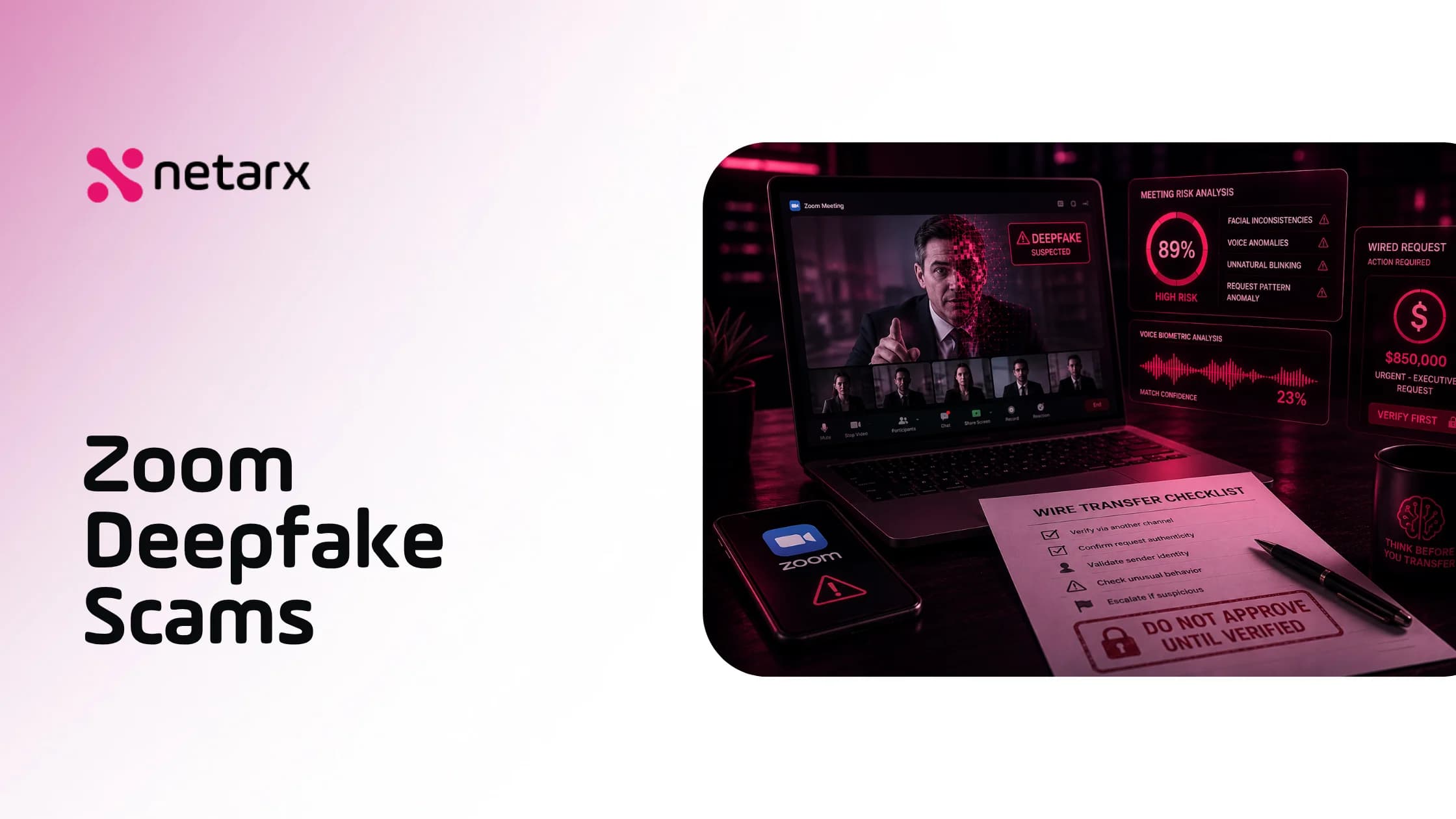
A Zoom deepfake scam puts an AI-cloned executive on a live call to pressure finance staff into approving a fraudulent wire. One such scam cost engineering firm Arup $25 million.
On the call, watch for lip-sync drift, glassy eyes and odd reflections, mismatched lighting, warping around the hairline, filtered or camera-off video, and studio-clean audio.
The biggest tell is behavioral: an urgent, confidential wire request that pressures you to skip normal approval steps.
blog
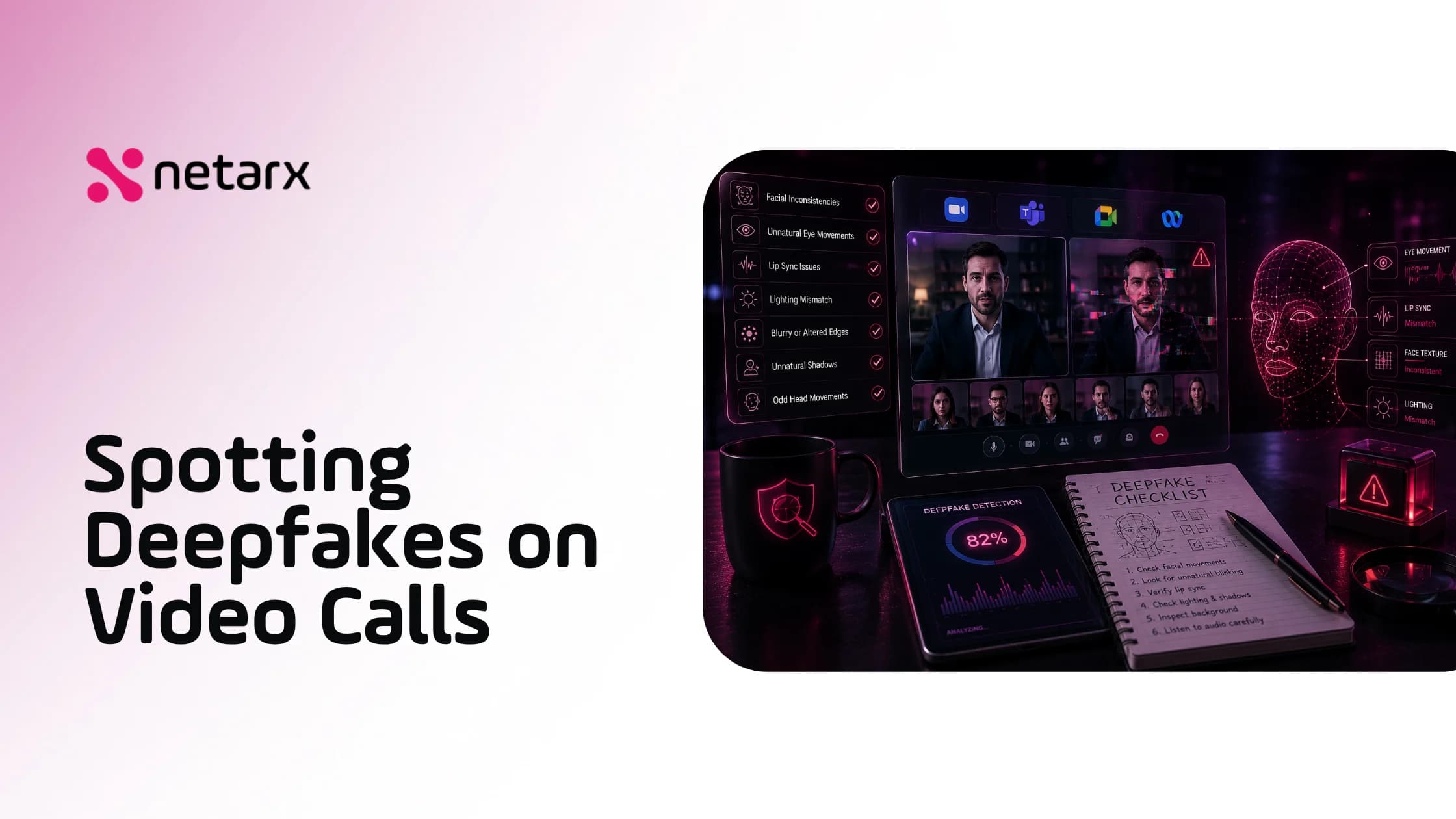
Deepfake video calls are live meetings where an executive's face and voice are AI-generated. One tricked an Arup employee into wiring $25 million.
Watch for lip-sync drift, odd eye reflections, mismatched lighting, blurred facial edges, flat audio, and urgent, secret payment requests.
blog
Deepfake fraud is the use of AI-generated voice, video, image, or text to impersonate a real person to steal money, credentials, or access.