
Chief Executive Officer
Published: December 16, 2025
Single-signal deepfake detection (API tools that scan a file for AI artifacts) is reactive, narrow, siloed, and stuck in a model arms race, so it can’t stop a multi-channel impersonation attack.
A resilient defense is a multi-signal platform: media detection + identity validation + cross-channel shared awareness, shifting from “is this file fake?” to “is this interaction authentic?”
Most deepfake detection tools are single-signal, they analyze a media file (audio, video, or image) for AI artifacts and nothing else. That makes them fundamentally flawed for enterprise security: they are reactive (the content is already inside), narrow (they ignore identity, behavior, and context), locked in a model arms race with generative AI, and siloed per workflow.
The fix is a multi-signal, cross-channel platform: combining media detection with identity validation and shared awareness across email, voice, video, and messaging, so the question shifts from “Is this file a deepfake?” to “Is this interaction authentic and trustworthy?”

Detection-only is reactive. It flags fakes after they’re already inside.
One signal isn’t enough. File analysis ignores identity, behavior, and context.
Silos lose. API tools don’t correlate threats across email, voice, and video.
The arms race never ends. Model-only detection degrades as generative AI improves.
Platforms win. Multi-signal + identity validation + shared awareness beats a point tool.
In This Article
The rapid evolution of generative AI presents a complex and expanding threat landscape for IT security professionals. Deepfakes and other forms of synthetic media are no longer niche concerns but mainstream tools for fraud, impersonation, and misinformation campaigns. In this environment, selecting the right defense platform is critical. While many solutions focus on detecting AI-generated media, this approach alone is insufficient.
This article compares two platforms: API-based solutions (capable deepfake detection tools), and Netarx, a comprehensive enterprise security platform. We will explore why Netarx’s multi-layered strategy, which combines media detection with identity validation and cross-channel awareness, offers a more resilient and proactive defense against the sophisticated, multi-faceted attacks that organizations face today.
Synthetic media detection tools have established themselves as a well-known names in deepfake detection. Their primary strength lies in identifying AI-generated media artifacts within audio, video, and image files through model-based inference. This API-first approach is valuable for developers and organizations looking to integrate a detection capability into specific workflows.
However, this "single-signal" (even if using multiple inference models) detection has inherent weaknesses in the context of enterprise security.
Reactive Posture:
Detection occurs after the malicious content has already entered the environment. It is a reactive measure, not a preventive one.
Limited Scope:
It focuses solely on the media artifact itself, ignoring the broader context of the interaction, the user's identity, and behavior across different communication channels. Simply stated, they do NOTHING to authenticate the user using context, cryptographic validation, and metadata. They can’t prevent a compromised human.
Model Arms Race:
The effectiveness of model-only detection is locked in a constant battle with the ever-improving capabilities of generative AI. As new models emerge, detection accuracy can degrade, requiring continuous retraining to keep pace.
Integration Burden:
As an API-first tool, they require integration into each separate workflow, creating security silos rather than a unified defense fabric.
For an IT security architect or manager, these limitations translate into significant operational gaps. A solution that only analyzes a file cannot stop an impersonation attack that leverages a combination of vishing, phishing, and social engineering across voice, email, and messaging platforms.
Netarx provides a fundamentally different approach. Instead of focusing on a single point of failure, Netarx operates as an enterprise security platform that delivers cross-channel, shared-awareness protection. This methodology is built on a dual-layered foundation: advanced media detection combined with robust identity validation.
Where these tools rely primarily on model-based inference to analyze media files, Netarx employs multi-signal detection. This superior approach incorporates a wider range of data points to build a more complete and accurate threat assessment.
These signals include:
Media Analysis:
Advanced detection models to identify synthetic artifacts in audio, video, and images.
Metadata Analysis:
Examination of file metadata for signs of manipulation or anomalous origins.
Behavioral Analytics:
Monitoring user behavior patterns to flag deviations from established norms.
Contextual Awareness:
Evaluating the context of the communication, such as the channel used, the timing, and the relationship between participants.
By correlating these diverse signals, Netarx can identify sophisticated threats that a single-signal solution would miss. It moves beyond simply asking, "Is this file a deepfake?" to answer the more critical question, "Is this interaction authentic and trustworthy?"
A critical challenge in deepfake and impersonation detection is minimizing false positives, which can erode trust in security systems and disrupt business operations. Solutions that rely solely on model-based, single-signal detection are prone to higher false positive rates due to limited context and insufficient corroborating evidence.
Netarx addresses this issue with its multi-signal detection engine. By factoring in media characteristics, metadata, behavioral patterns, and contextual signals—along with robust identity validation—Netarx achieves a far more accurate determination of authenticity. This holistic analysis substantially reduces the incidence of false positives, enabling security teams to focus on genuine threats instead of wasting resources investigating benign activities.
Furthermore, shared awareness across channels ensures that suspicious activity is validated using multiple independent data points before an alert is generated. This layered approach not only strengthens detection capability but also upholds operational efficiency and user confidence by ensuring that legitimate communications are not mistakenly blocked or flagged. As a result, organizations benefit from high-precision threat detection that aligns with demanding enterprise requirements.
Netarx provides a fundamentally different approach. Instead of focusing on a single point of failure, Netarx operates as an enterprise security platform that delivers cross-channel, shared-awareness protection. This methodology is built on a dual-layered foundation: advanced media detection combined with robust identity validation.
Cybercriminals do not operate in silos, and neither should your defenses. The API-based architecture lacks a native shared awareness layer, meaning a detection event on one channel (e.g., video) is not automatically correlated with suspicious activity on another (e.g., email).
Netarx is designed with a unified security framework that protects against impersonation across all major enterprise communication channels:
Voice
Video conferencing
Messaging and collaboration platforms
Detection events are correlated across these channels and users, creating a "shared awareness" layer. If an attacker attempts to impersonate an executive through a vishing call and a follow-up phishing email, Netarx connects these events. This holistic view enables faster, more accurate incident response and prevents attackers from exploiting gaps between siloed security tools.
A key differentiator for Netarx is its focus on proactive risk reduction. While the API-tool detects malicious content after it appears, Netarx implements mechanisms to prevent impersonation attempts from succeeding in the first place.
By combining media detection with strong identity validation—leveraging cryptographic assurance, device identifiers, and other methods—Netarx makes it extremely difficult for an attacker to successfully impersonate a legitimate user. This proactive stance hardens the enterprise against social engineering and fraud before a deepfake is even deployed, reducing the attack surface and minimizing the need for reactive clean-up.
Finally, Netarx is a comprehensive security platform with capabilities that extend beyond simple detection. It addresses critical enterprise needs that point solutions overlook.
Enterprise Policy Enforcement:
Allows administrators to define and enforce security policies across the organization.
Response Orchestration:
Facilitates coordinated incident response workflows, ensuring that threats are managed efficiently and effectively.
Continuous Data Protection:
Implements continuous auditing and provides recovery options to quickly remediate unwanted changes, such as those made to critical Active Directory objects.
This platform-based approach provides IT security professionals with the centralized management, visibility, and control necessary to secure a modern enterprise. It closes the enterprise workflow gaps that are often left open by API-based detection tools.
Feature | Netarx | API-based |
|---|---|---|
Primary Approach | Enterprise security platform with multi-signal detection | API-first, model-based media detection tool |
Detection Method | Multi-signal (media, metadata, behavior, context) | Single-signal (model inference on media files) |
Channel Coverage | Unified across email, voice, video, and messaging | Limited; requires point-by-point integration |
Threat Posture | Proactive prevention and reactive detection | Primarily reactive detection |
Key Capability | Protects against impersonation and fraud | Detects AI-generated artifacts in media |
Awareness Layer | Shared awareness across users and channels | No native shared awareness layer |
Enterprise Focus | Includes policy enforcement and response orchestration | Limited focus on broader enterprise workflows |
While media detection tools offer valuable technology for identifying AI-generated media, its narrow focus on single-signal detection makes it a point solution, not a complete defense. In the face of multi-channel, AI-driven attacks, relying on such a tool is like installing a strong lock on the front door while leaving the windows wide open.
Netarx provides the comprehensive security architecture required to protect against modern threats. By integrating multi-signal detection, cross-channel shared awareness, and proactive identity validation into a single enterprise platform, Netarx delivers a more resilient, scalable, and reliable defense. For IT security professionals tasked with protecting their organizations from impersonation and fraud, the choice is clear: a comprehensive platform will always outperform a standalone tool.
SOURCES & REFERENCES
Science & Tech Spotlight: Combating Deepfakes (GAO-24-107292), U.S. Government Accountability Office (March 11, 2024). Finds that detection methods may not reliably identify deepfakes and that creators keep finding ways to evade detection.
Reducing Risks Posed by Synthetic Content (NIST AI 100-4), NIST / U.S. AI Safety Institute (November 2024). Reviews the technical limits of synthetic-content detection and the value of provenance and authentication.
Criminals Use Generative Artificial Intelligence to Facilitate Financial Fraud, FBI Internet Crime Complaint Center (IC3), Public Service Announcement (December 3, 2024). Describes multi-channel AI impersonation and recommends out-of-band verification.
Use Secure Cloud Identity and Access Management Practices, NSA & CISA Cybersecurity Information Sheet (March 7, 2024). Recommends phishing-resistant MFA and stronger identity and access management.
Digital Identity Guidelines (NIST SP 800-63-4), Second Public Draft, NIST (August 2024). Defines identity-proofing, authentication, and assurance levels for validating who a user really is.
Alert on Fraud Schemes Involving Deepfake Media Targeting Financial Institutions (FIN-2024-Alert004), U.S. Treasury Financial Crimes Enforcement Network (FinCEN) (November 13, 2024). Reports rising deepfake media used to bypass identity verification.

 Verified
Chief Executive Officer
CEO/Founder of Netarx LLC, Real-time detection of deepfake and social engineering threats via enterprise video, voice and email. Managing Partner of Koach Capital, a Private Equity firm managing a multitude of commercial real estate (CRE) funds whose focus is retail sale-leasebacks. Sandy's entrepreneurial success began by founding a network integration and services provider that served large enterprises. We focused on advanced technologies including Business Intelligence (BI), Network & Information Security, Virtualization, Storage Area Networks, Unified Communications and Data Center Services. In 2009, Netarx acquired the VAR business of Analysts International (including Sequoia and Entree Systems). In 2011 Netarx was acquired by Logicalis (a division of Datatec - Symbol LSE: DTC) and stayed on as its Chief Technology Officer. He continued to build by founding Verge.io (Formerly Yottabyte) and Service.com. Also, Sandy served as a General Partner of Ludlow Ventures, a venture capital fund focusing on investments in early-stage tech companies. Sandy contributes to the community via lectures, publications and developing new technologies - he currently holds 8 Patents.

Most are “single signal”, they scan a media file for AI artifacts and ignore everything else. That makes them reactive (the content is already inside), narrow (no identity, behavior, or context), siloed per workflow, and locked in a model arms race with generative AI.
blog
Deepfake detection asks whether media is synthetic or manipulated. It catches AI faces and cloned voices, but can miss high quality fakes and says nothing about who is really on the other end.
blog
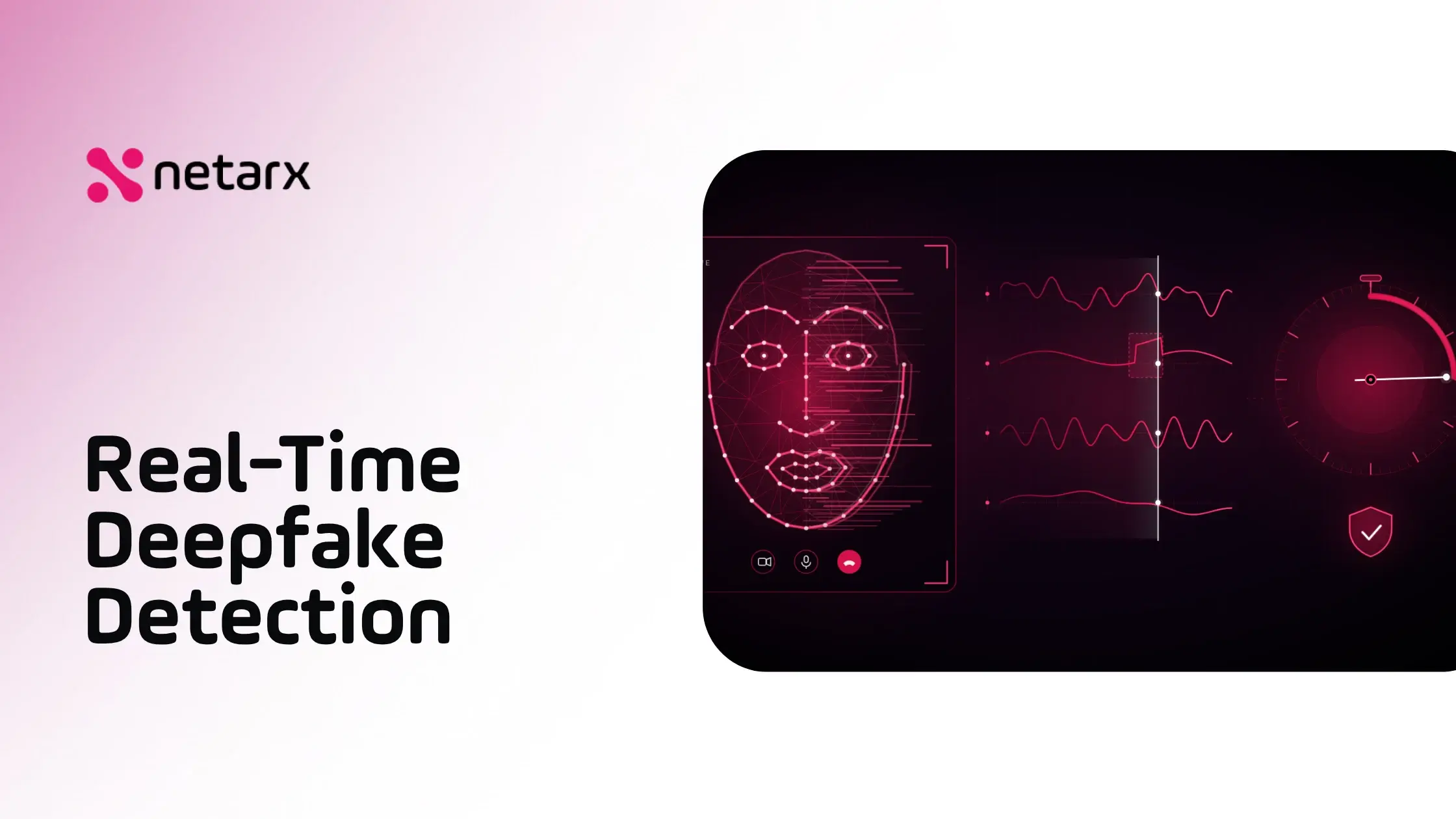
Real-time deepfake detection analyzes live video, voice and messages as they happen and returns a trust verdict while the conversation is still in progress, before anyone acts on a fraudulent request. It works by streaming short windows of media and context through several models at once: visual forensics, audio forensics, metadata and device checks, and behavioral signals, then fusing them into one verdict.
blog
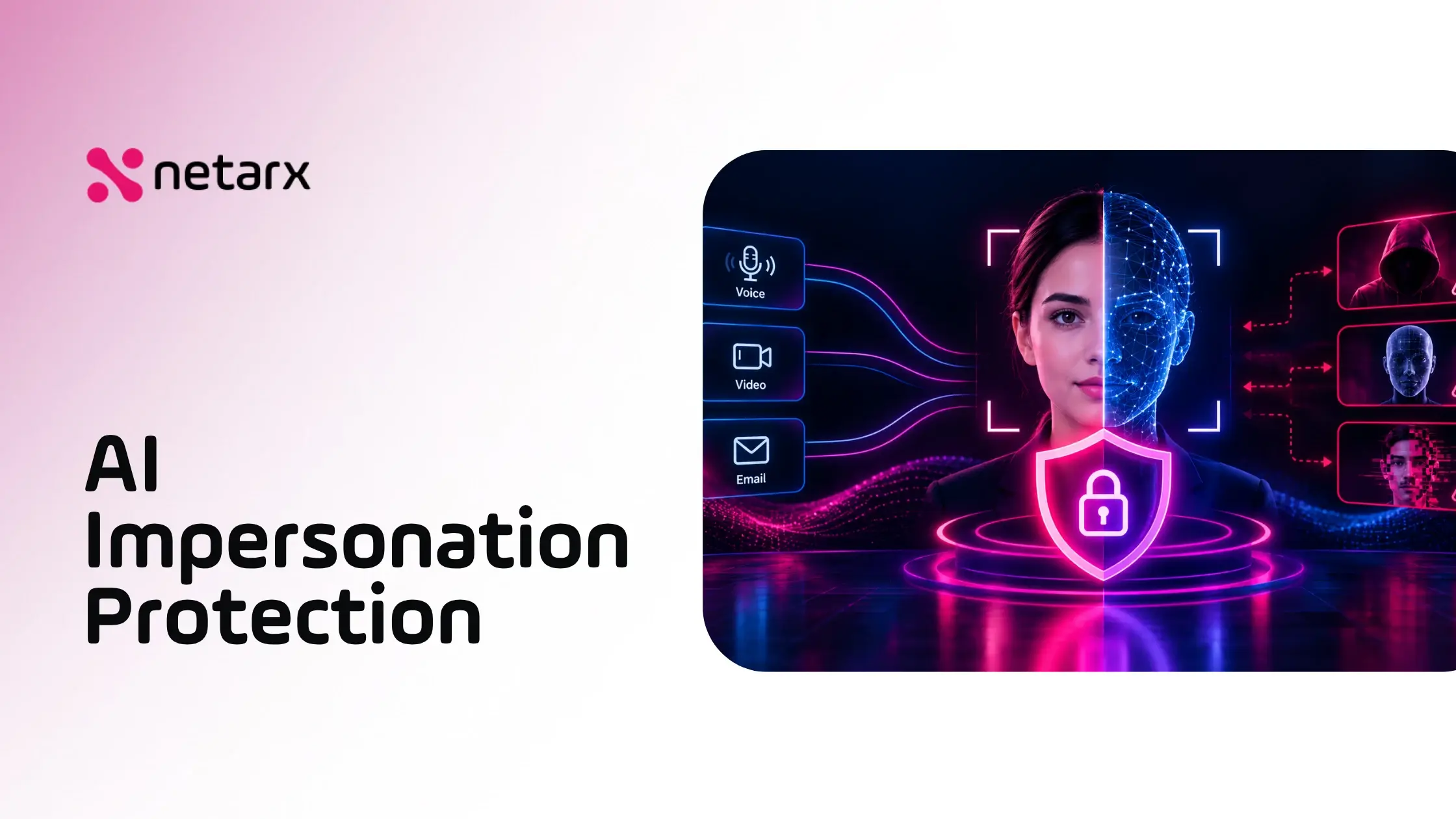
AI impersonation fraud uses cloned voices, deepfake video and AI-written messages to pose as executives, vendors or candidates. It is mainstream: 62% of organizations saw a deepfake attack in the past year (Gartner, 2025).